Interview: Master Swordsmith Hiroshi Tanaka
You have been folding steel for more than four decades. What still surprises you about the process?
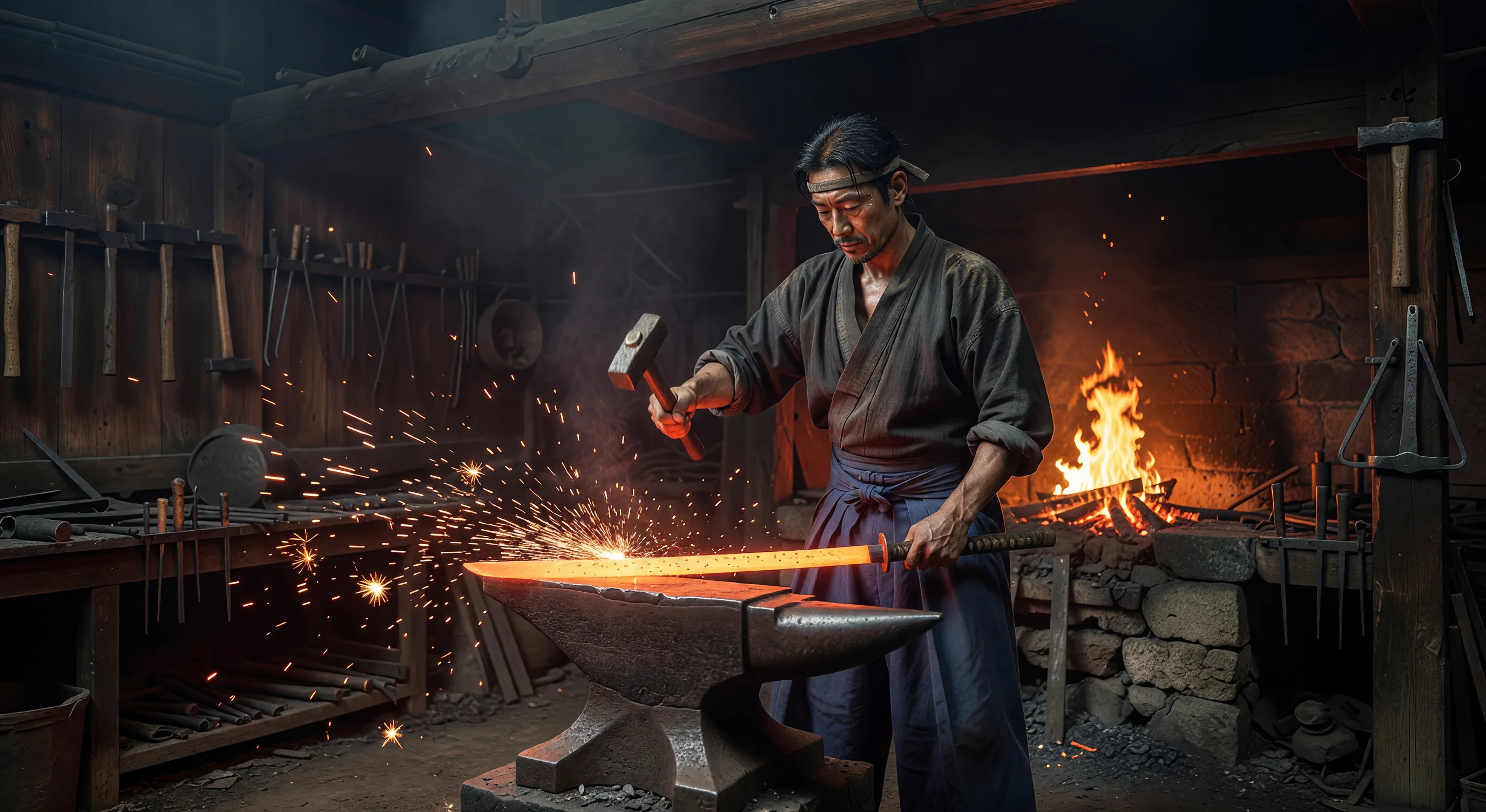
The fire surprises me every time. People imagine that after forty years I can read the colour of the steel perfectly — 800 degrees, 1000 degrees, 1250 — yes, I can do that. But the fire is alive. Each batch of tamahagane steel has its own character. Some mornings the steel speaks to me quickly, other mornings it takes half the day before I feel that we understand each other. The moment of tameshigiri — the test cut — still makes my hands tremble slightly. Forty years, and that has never changed.
The tamahagane smelting process is incredibly demanding. Why not use modern high-carbon steel?
A katana made with modern steel is a tool. A katana made with tamahagane is a conversation between the swordsmith and eight hundred years of accumulated knowledge. The traditional tatara smelting process produces a steel with micro-variations in carbon content that, when forged and folded, create the hada — the wood-grain pattern visible in the blade. No two blades are alike. That uniqueness is not a defect of the process; it is the whole point of the process. When I look at a blade I made twenty years ago, I can see who I was then. Modern steel would not give me that.
Are young people apprenticing with you? How do you think about the future of the craft?
I have two apprentices currently — one from Aichi, one from Kanagawa. Both young, both serious. The examination to become a licensed swordsmith is extremely difficult; the government strictly limits the number of blades a swordsmith can produce each year. This keeps the craft alive by maintaining its value, but it also means there is no quick path. My apprentices know they will spend at minimum five years before they can hold a hammer with complete confidence. The craft self-selects for patience. I think that is correct. Impatience has no place at the forge.
What would you say to someone holding a katana for the first time?
I would say: be still. Most people want to move immediately — to swing it, to test the weight. But the first thing a blade teaches you is stillness. Hold it with both hands, eyes closed, and simply feel its balance. A well-made katana will feel like an extension of your spine. If it feels like a foreign object, either the blade is wrong or you are not yet ready to hold it. Prepare yourself first. The blade will wait.