Knowledge & Stories

Traditional Crafts of Japan

In-depth articles on the techniques, histories, and living practitioners of Japan's most treasured handcraft traditions.

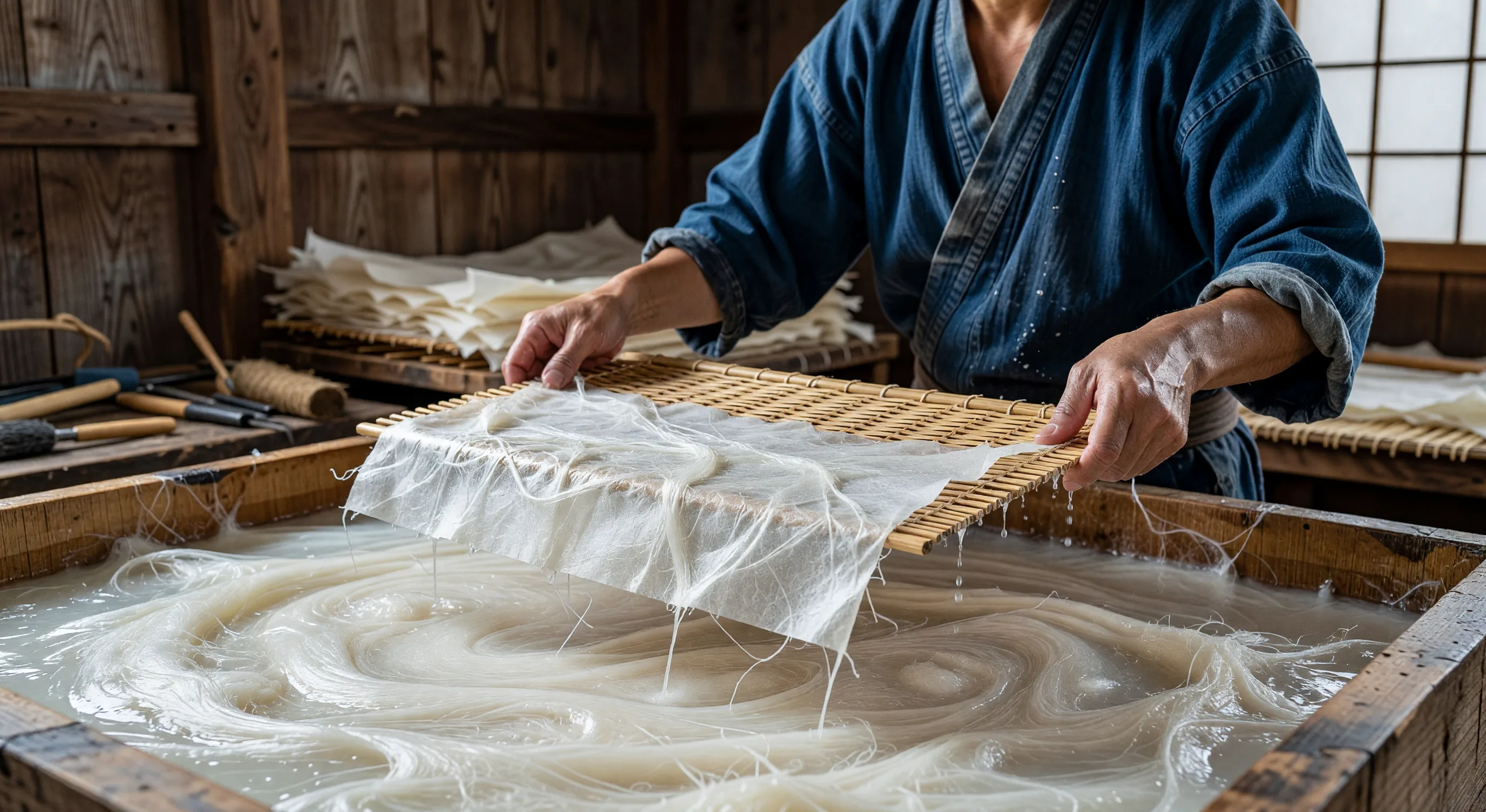
Artisan lifting a wooden frame from a vat of kozo fibre suspension during traditional washi paper making in Echizen, Japan

The Art of Washi: Japan's Sacred Paper

Long before the age of printing presses and digital screens, the Japanese had perfected a paper unlike any other in the world. Washi — whose name simply combines the characters for Japan (wa) and paper (shi) — is hand-made from plant fibres, typically kozo (paper mulberry), mitsumata, or gampi. Its production demands precise knowledge of water temperature, fibre preparation, and the delicate art of the shake — the oscillating motion used to build up an even sheet on the bamboo screen. Each sheet is pressed and dried under careful supervision, emerging with a translucency, strength, and tactile warmth that no machine-made paper can replicate.

The origins of washi in Japan are traced to the 7th century, when Buddhist monks used it to copy sacred sutras. Over the centuries, the craft diversified into hundreds of regional varieties. Echizen in Fukui Prefecture became the established capital of washi production, its sheets prized by court calligraphers and emperors alike. Ogawa-machi in Saitama produced translucent papers for shoji screens. Mino, in Gifu, developed sheets of extraordinary longevity — some washi documents from the Nara period (710–794) survive in near-perfect condition today, a testament to the archival quality that synthetic papers cannot hope to match.

UNESCO inscribed traditional washi craft onto its Intangible Cultural Heritage list in 2014, recognising that it represents not merely a manufacturing technique but a philosophy of making. The papermaker does not fight the fibre; she coaxes it into alignment, working with the natural properties of the plant, the mineral content of the local water, and the seasonal temperatures that affect the fibre's behaviour. A finished sheet of washi is thus a record of a particular place, a particular season, and the particular hands that made it — an irreducibly local object in an age of global uniformity.

Continue Reading
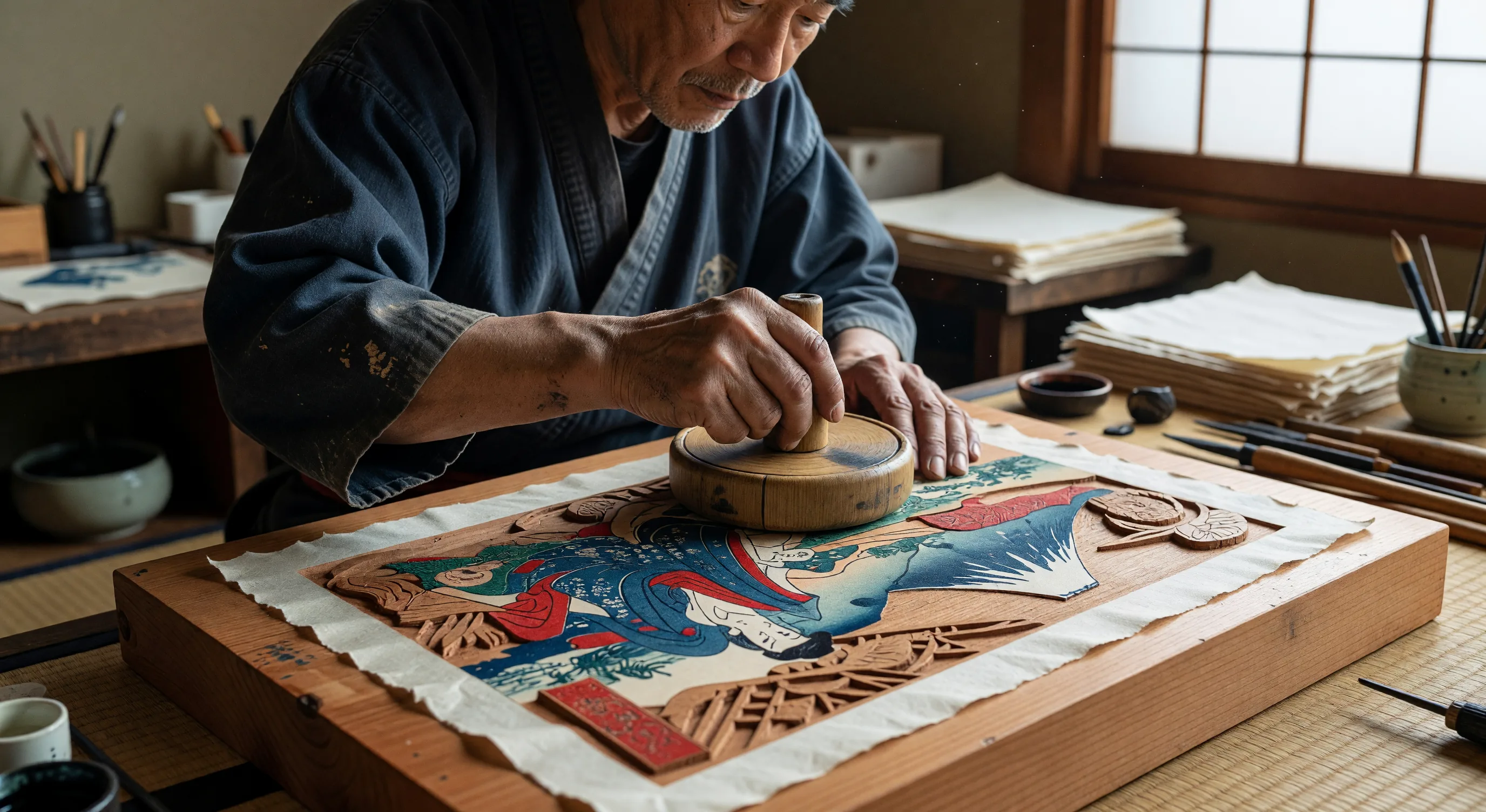
Artisan carving fine detail into a cherry wood block for ukiyo-e woodblock printing, surrounded by printed proof sheets showing kabuki actor portraits

Ukiyo-e: The Floating World in Woodblock

The term ukiyo-e — pictures of the floating world — evokes the transient pleasures of Edo-period Japan: the theatre, the teahouse, the sumo ring, the journey along the Tokaido road. Flourishing from the 17th century until the Meiji era, ukiyo-e prints were originally an affordable popular art form, mass-produced through precise collaboration between designer, carver, and printer. A single finished image might require dozens of separate cherry-wood blocks, each inked with a different colour and pressed onto dampened washi with exact registration — a feat of coordination as much as artistry.

The great names — Hokusai, Hiroshige, Utamaro — are known worldwide, but the craft that gave them form is less celebrated than it deserves. A skilled carver must cut with the grain of the cherry wood to achieve the finest lines, sharpening tools throughout the day as the resinous wood quickly dulls even the best blades. The printer, meanwhile, must control the moisture and pressure of each impression with uncanny consistency. Today fewer than a hundred practitioners maintain the full traditional process. Organisations such as Adachi Hanga in Tokyo train new apprentices, hoping to carry the tradition forward into an era where even the specialist inks and papers are increasingly difficult to source.

Continue Reading

Raku Pottery: The Tea Master's Art

Raku ware, born from the friendship between tea master Sen no Rikyu and potter Chojiro in 16th-century Kyoto, represents perhaps the purest expression of wabi-sabi in ceramics. Each bowl is formed entirely by hand — no wheel is used — and fired individually at low temperature. The resulting surfaces carry the marks of fingers, fire, and chance: irregular forms, smoky glazes, and small imperfections that make each piece unrepeatable. For the practitioner of chado (the way of tea), the rough texture of a raku chawan against the palm is integral to the ceremony itself.

Read More

Ikebana: The Way of Flowers

Where Western flower arranging prizes abundance and symmetry, ikebana — the Japanese art of flower arrangement — seeks asymmetry, negative space, and the expression of natural movement. The three principal lines of most arrangements represent heaven, earth, and humanity. Practitioners study under formal schools — Ikenobo, the oldest, founded in the 15th century; Ohara; Sogetsu — each with its own canon of forms and philosophy. A serious practitioner may spend years mastering the basic forms before being entrusted with more free expression. The discipline teaches not only the placement of stems but attentive observation of each plant's particular character and seasonal meaning.

Read More

Origami: Geometry and Grace

What began as a ceremonial practice — noshi paper folds adorning gifts at Shinto festivals — evolved over centuries into one of Japan's most widely known arts. The key discipline of origami is that a single, uncut sheet of paper must yield the final form: no glue, no scissors, only folds. In practice this constraint becomes a profound creative engine. Contemporary origami artists such as Satoshi Kamiya achieve staggeringly complex insects, dragons, and anatomically accurate animals from a single square. At the same time, the simple crane — foldable by a child in minutes — carries one of Japan's most resonant symbolic traditions: the belief that one who folds a thousand cranes (senbazuru) will be granted a wish.

Read More

Indigo Dyeing: The Deep Blue Tradition

Japan has cultivated and processed indigo — ai — for more than a thousand years. The deeply saturated blues achieved through repeated immersion in fermented indigo vats are unlike any synthetic equivalent: richer, more complex, and possessed of a quality Japanese dyers call ai-iro no fukasa, the depth of indigo colour. Different regional traditions produce distinctive results: Tokushima Prefecture is the heartland of Japanese indigo cultivation; the shibori resist-dyeing tradition of Kyoto uses binding, stitching, and clamping to create intricate patterns in the cloth before dyeing; and the rough-woven indigo cotton of Edo-period craftsmen gave rise to a distinctively Japanese blue aesthetic that fascinated early Western visitors to Japan.

Read More